
How to Find Your Ideal Client: A Regenerative Lens
Note: The following content was first delivered as an asynchronous audio teaching in the first iteration of The Vision Society, recorded and delivered by Daje Aloh in 2024. Enjoy.
This training is specific to service-based entrepreneurs who serve clients one-on-one or in group formats. It can be applied to both online and in-person offerings and utilizes frameworks found in the Social Media for Healers course.
Most trainings on identifying your ideal customer rely on outdated thinking that asks you to become a “problem-solver” for people you haven’t met yet. This impulse to solve problems for people we haven’t met and have no data about can lead to work relationships based on assumptions, fantasy, and idealism, ultimately leaving us feeling mechanical and misaligned in our work.
The updated model we offer in the Storywork Studio will support you in identifying who your customer is, alleviating any confusion about who to talk to in your marketing, who to build products/offerings for, and why.
This training utilizes a soul-centric approach and a regenerative lens to help you identify who your customer is and build offerings that serve them and their needs/desires over time.
"A Healthy Society is, among other things, sustainable, just, and compassionate. It is sustainable because it is expressly organized as an integral component of the greater community of Earth...such a society cannot be created by simply sitting down and planning one, no matter how enlightened the designers or design principles. It arises only through a natural process of cultural evolution galvanized by soul-infused actions."
Bill Plotkin, Nature and the Human Soul
“We are by now so accustomed to the cult of expertise that the very notion of honoring and paying heed to our directly felt experience of things—of insects and wooden floors, of broken-down cars and bird-pecked apples, and the scents rising from the soil—seems odd and somewhat misguided as a way to find out what’s worth knowing.”
David Abrams, Becoming Animal
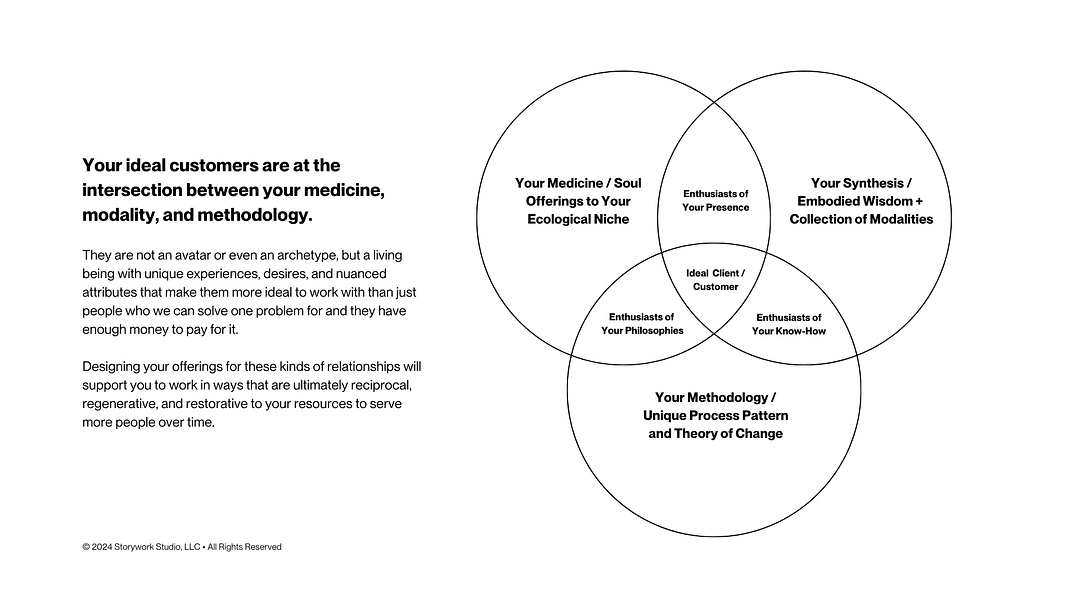
Your ideal customer is not an avatar or an archetype, but a living being with unique experiences, desires, and nuanced attributes that make them more ideal to work with than just people who have a problem you can solve and enough money to pay for it. Designing your offerings for these kinds of relationships will support you in working in ways that are ultimately reciprocal, regenerative, and restorative to your resources, enabling you to serve more people over time.
Use this model to clarify who your customers are and to learn where to look for them/attract them in the market.
Your Medicine—Your Offerings to Your Ecological Niche
Your ecological niche, or medicine, represents the unique role or contribution you bring to the world. This is the soul of your offerings.
What is your unique offering or medicine?
Who are the enthusiasts of your presence—those who are naturally drawn to what you bring into the world?
Exercise: Who are the people who are already in your ecological niche? How do they reflect your essence and soul back to you when you share your offerings, writings, and words? Name these people specifically and map them in your own Venn diagram.
Your Synthesis—Your Embodied Wisdom and Collection of Modalities
Your synthesis of modalities refers to the blend of tools, techniques, and wisdom that you have embodied over time. This synthesis is what differentiates your approach from others.
What are the key modalities that form the foundation of your work?
Who are the enthusiasts of your know-how—people who appreciate and seek out your particular blend of modalities?
Exercise: List your primary modalities and consider who would be attracted to your unique combination of skills and embodied wisdom.
Your Methodology—Your Unique Process Pattern or Theory of Change
Your methodology is the structured process or theory of change that you use to guide clients from where they are to where they want to be. It’s the practical application of your niche and modalities.
What is your unique process or methodology?
Who are the enthusiasts of your philosophies—clients who resonate with your approach to creating change?
Exercise: Outline your methodology as a three-part change process or wheel of change. Identify the type of client who would be drawn to this kind of change process
Finding the Intersection—Your Ideal Customer
Your ideal customer lies at the intersection of these three areas. These are people who are not only drawn to your presence, know-how, and philosophies but also deeply resonate with all three.
Exercise: Using the Venn diagram as a guide, map out the attributes of your ideal customer. Identify the commonalities across the three circles—who are the people you currently know or have met who fit into all three categories?
